Category: Finance

  • Income Tax Slab in Budget 2026 Explained: Latest Rates, No Change Policy, and What It Means for Taxpayers

    Income Tax Slab in Budget 2026 Explained: Latest Rates, No Change Policy, and What It Means for Taxpayers

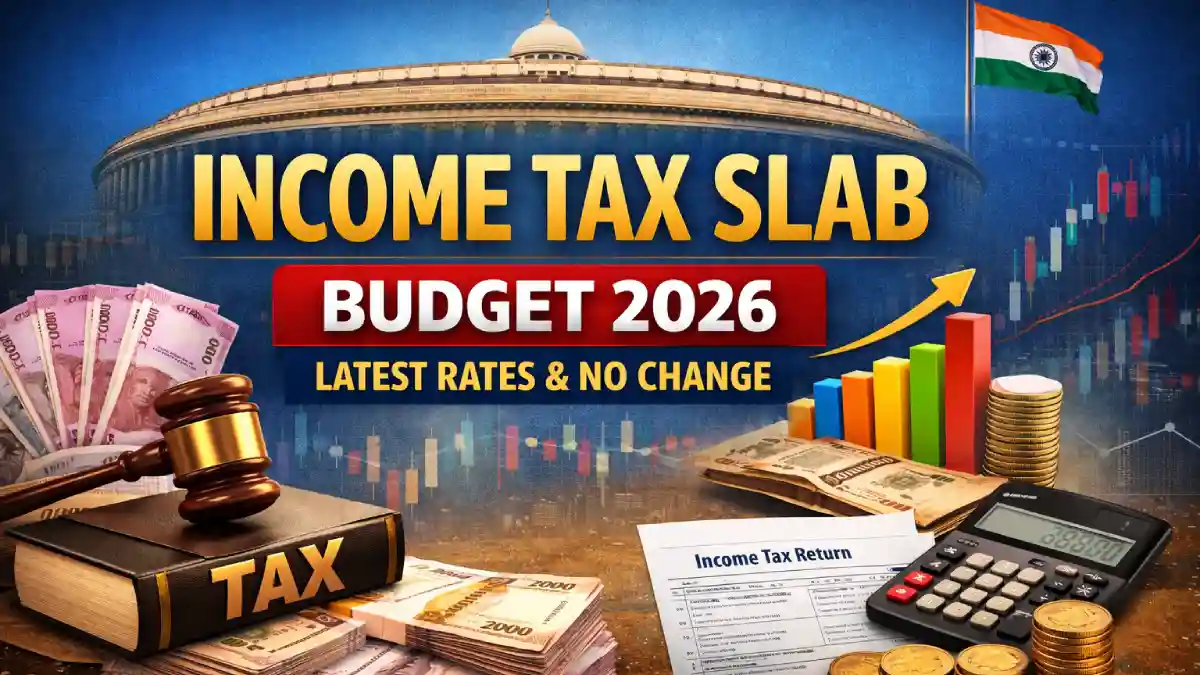
    In the Union Budget 2026–27, presented by Finance Minister Nirmala Sitharaman on February 1, 2026, one of the most anticipated announcements was the income tax slab structure for individual taxpayers. After real-time review of the latest budget updates from Indian Express and NDTV, it’s confirmed that there were no changes to the income tax slabs for the upcoming financial year. Despite expectations for relief or revisions, the government maintained the existing framework introduced in previous budget cycles to ensure stability and predictability for taxpayers.

    New Tax Regime Slabs for FY 2026–27 (Effective April 1, 2026)

    Under the new tax regime — which has become the default system for individuals — the slab rates and structure are as follows:

    • Income up to ₹4,00,000: Nil
    • ₹4,00,001 to ₹8,00,000: 5%
    • ₹8,00,001 to ₹12,00,000: 10%
    • ₹12,00,001 to ₹16,00,000: 15%
    • ₹16,00,001 to ₹20,00,000: 20%
    • ₹20,00,001 to ₹24,00,000: 25%
    • Above ₹24,00,000: 30%

    This slab system was introduced in the previous Budget cycle and has been retained without revision in 2026. The government’s decision to keep the slabs unchanged was confirmed by NDTV’s live coverage, which explicitly stated that there were no changes in income tax slab rates this year — a key point for taxpayers who were watching budget day announcements closely.

    What This Means for Taxpayers

    Even though the slab rates remain the same, many individuals effectively pay zero income tax up to about ₹12 lakh of annual taxable income. This is due to the Section 87A rebate of up to ₹60,000, combined with the standard deduction (₹75,000 for salaried taxpayers) under the new regime, allowing many middle-class taxpayers to be exempt from tax up to ₹12.75 lakh or more.

    In contrast, the old tax regime continues to exist as a separate option. Under that system, the basic exemption limit is lower and deductions are more extensive (such as Section 80C, home loan interest, etc.), but many taxpayers find the new regime simpler and more beneficial unless they have significant deductions planned.

    Key Takeaway

    For Budget 2026–27, the government chose to retain the existing income tax slab structure rather than introduce new rate cuts or changes. This decision was aimed at maintaining tax stability for individuals while focusing on broader fiscal goals and reforms.

    FAQs: Income Tax Slab in Budget 2026

    Q1. Has the income tax slab changed in Budget 2026?

    No, the Union Budget 2026–27 did not announce any changes to the income tax slab rates. Both the new tax regime and the old tax regime slabs remain the same as the previous financial year.

    Q2. What are the income tax slabs under the new tax regime in Budget 2026?

    Under the new tax regime for FY 2026–27, income up to ₹4 lakh is tax-free. Income between ₹4 lakh and ₹24 lakh is taxed at progressive rates ranging from 5% to 25%, while income above ₹24 lakh is taxed at 30%.

    Q3. Is the new tax regime still the default option in Budget 2026?

    Yes, the new tax regime continues to be the default income tax system. Taxpayers can opt out and choose the old tax regime if they wish while filing their income tax returns.

    Q4. Is income up to ₹12 lakh tax-free in Budget 2026?

    Effectively, yes. Due to the Section 87A rebate and standard deduction available under the new tax regime, individuals with taxable income up to around ₹12 lakh may not have to pay any income tax.

    Q5. Did Budget 2026 provide any income tax relief for the middle class?

    Budget 2026 did not provide direct relief through slab changes or tax rate cuts. However, the government focused on tax stability, simplified compliance, and procedural ease rather than reducing tax rates.

    Q6. What is the status of the old tax regime in Budget 2026?

    The old tax regime remains unchanged and continues to offer deductions and exemptions such as Section 80C, 80D, and home loan interest benefits. Taxpayers can choose it if it is more beneficial for them.

    Q7. When will the new Income Tax Act announced earlier come into effect?

    As per Budget announcements, the new simplified Income Tax Act is expected to come into force from April 1, 2026, aiming to make tax laws easier to understand and comply with.

    Q8. Should taxpayers expect changes in income tax slabs in the next budget?

    While no changes were announced in Budget 2026, future revisions will depend on economic conditions, revenue requirements, and government policy priorities.
  • Union Budget 2026–27 Highlights: Key Announcements Shaping India’s Economic Direction

    Union Budget 2026–27 Highlights: Key Announcements Shaping India’s Economic Direction

    India’s Finance Minister Nirmala Sitharaman presented the Union Budget 2026–27 in Parliament on 1 February 2026, unveiling a wide-ranging set of policies aimed at economic growth, infrastructure, taxation reforms, and sector-wise development. The Budget focuses on strategic investment, fiscal discipline, and long-term reforms to accelerate India’s domestic capabilities and global competitiveness. The following are the key highlights of the Union Budget 2026 from live coverage and reporting by multiple news sources.

    1. Record Capital Expenditure to Boost Growth

    The government announced a record capital expenditure allocation of ₹12.2 lakh crore for the fiscal year 2026–27, significantly higher than the previous year’s figure. This large capex aims to drive infrastructure development across transport, logistics, urban projects, and energy networks — reinforcing India’s investment-led growth strategy.

    Also Read: Sensex and Nifty Slide Sharply After Union Budget 2026: What Happened in the Stock Market

    2. Seven High-Speed Rail Corridors and Freight Networks

    One of the most eye-catching infrastructure announcements was the plan to build seven new high-speed rail corridors connecting key urban and economic hubs such as Mumbai–Pune, Pune–Hyderabad, and Delhi–Varanasi. In addition, a dedicated east-west freight corridor from Dankuni (West Bengal) to Surat (Gujarat) was proposed to strengthen goods movement.

    3. Support for Advanced Manufacturing and Technology

    The Budget unveiled the India Semiconductor Mission 2.0 with an outlay of ₹40,000 crore to deepen India’s semiconductor manufacturing ecosystem, promote research and training, and boost technology-led industry expansion. There was also a substantial push for rare-earth mineral corridors in states like Odisha, Kerala, Andhra Pradesh, and Tamil Nadu to secure critical raw materials for high-tech sectors.

    Also Read: Income Tax in Union Budget 2026: What Changed and What Stayed the Same

    4. Fiscal Discipline and Deficit Target

    The government reaffirmed its commitment to fiscal prudence, targeting a fiscal deficit of approximately 4.3 % of GDP for 2026–27 — slightly lower than the current fiscal year to maintain stability while expanding investment.

    5. Tax Reforms and Ease of Compliance

    The Budget proposed reforms including a simplified Income Tax Act coming into effect from April 2026, redesigned return filing processes, and extended timelines to ease compliance for taxpayers. Measures such as reducing Tax Collected at Source (TCS) on overseas travel and education remittances under the Liberalised Remittance Scheme were also introduced.

    Also Read: Budget 2026 Explained: Why This Is the Most Confident and Assured Phase of Modinomics Yet

    6. Agriculture and Rural Development

    The allocation for the agriculture sector was increased to ₹1.63 lakh crore to support high-value crops, allied activities, and modern agricultural practices designed to improve farmer incomes and rural employment.

    7. MSME, Textile, and Village Industry Boost

    Comprehensive support for Micro, Small & Medium Enterprises (MSMEs) was laid out, including growth funding and targeted programs for traditional industries like khadi, handloom, and silk — particularly in states like Uttar Pradesh — to spur employment and production growth.

    8. Defence and Strategic Sector Allocations

    The Budget allocated ₹7.85 lakh crore to the defence sector, prioritising modernization, procurement of advanced equipment, and strategic force enhancement. Capital outlay and pension obligations were also addressed to balance current and future defence requirements.

    9. Education, Healthcare, and Human Development

    Investments were announced for healthcare infrastructure, allied health workforce training, and education-to-employment initiatives. This includes establishing new hostels for girls, expanding skill development programs, and setting up content creator labs in schools and colleges for technology and creative sector education.

    10. Environment, Clean Energy, and Infrastructure Schemes

    The Budget introduced support for solar power, battery storage, and electric vehicles in key regions, plus customs duty reductions on solar inputs and related technologies to drive clean energy adoption and cost-effective renewable systems.

    Summary

    Union Budget 2026–27 prioritises infrastructure, technology-driven manufacturing, fiscal discipline, and structural reforms while extending targeted support to agriculture, MSMEs, and human capital development. By blending record public investment with tax compliance reforms and sector-specific initiatives, the Budget aims to strengthen India’s long-term economic trajectory and global competitiveness.
  • Sensex and Nifty Slide Sharply After Union Budget 2026: What Happened in the Stock Market

    Sensex and Nifty Slide Sharply After Union Budget 2026: What Happened in the Stock Market

    India’s benchmark stock indices BSE Sensex and NSE Nifty 50 experienced a significant downturn on February 1, 2026, immediately after the Union Budget 2026–27 announcement by Finance Minister Nirmala Sitharaman. This marked one of the most negative market responses on a budget day in recent years, with major declines driven by investor concerns over key policy changes — especially tax increases on derivative trades.

    Strong Initial Optimism Fades Quickly

    When the Budget was unveiled during a special Sunday trading session, markets initially showed mixed sentiment. However, this optimism quickly faded as details of the Budget emerged, particularly the increase in the Securities Transaction Tax (STT) on equity derivatives such as futures and options. This move raised trading costs and spooked traders and institutional investors.

    Sensex and Nifty — Key Movements

    According to BusinessToday.in, the BSE Sensex plunged 1,546.84 points (about 1.88%) to close at approximately 80,722.94, while the Nifty 50 slid 495.20 points (around 1.96%) to finish near 24,825.45. These steep losses wiped out an estimated ₹10 lakh crore of market capitalization, signaling widespread selling pressure across sectors.

    NDTV also reported that at certain points during trading, the indices showed even larger drops, with the Nifty nearing a fall of nearly 3% as investors reassessed the cost of derivatives trading after the Budget’s announcements.

    Why Did Markets React So Negatively?

    The sharp sell-off in Sensex and Nifty was largely attributed to:

    1. Higher Taxes on Derivative Trades:

    The STT on futures was raised to 0.05% from 0.02%, and on options premiums to 0.15% from 0.10%; such increases directly affect traders and brokerage margins. Higher costs tend to reduce trading volumes, especially in the derivatives market, which had grown substantially in recent years. This unexpected change triggered quick selling, particularly among active traders and hedge funds.

    2. Lack of Immediate Market-Friendly Incentives:

    Investors were also disappointed by the absence of stronger fiscal incentives or measures for attracting foreign capital inflows — a point of concern given recent net outflows of foreign investment from Indian equities. This added to market unease.

    3. Broad Selling Across Sectors:

    Market breadth weakened significantly as most stocks ended in the red across various sectors, reflecting a widespread risk-off sentiment rather than sector-specific weakness.

    Market Analysts’ Views

    Analysts highlighted that the Budget’s shift toward higher transaction costs was meant to discourage speculative activity in derivatives, but the abrupt nature of this change caught traders off guard. Many pointed out that even marginal increases in tax rates can disproportionately affect derivative volumes and market sentiment.

    What It Means for Investors

    The sharp reaction of Sensex and Nifty suggests that markets are currently prioritizing liquidity considerations and tax environments over long-term Budget announcements like infrastructure spending or economic reforms. While the broader economic goals of the Budget remain relevant, the immediate impact shows that investors are sensitive to policy changes that affect trading costs and market participation dynamics.